
Table of Contents
PHPP - validated and proven in practice
The PHPP was developed with the purpose of creating an easy to use every day design tool that reliably produces results reflecting the building's energy performance. Based initially on the stationary energy balance approach from international standards (ISO 137990), the algorithms implemented in PHPP have been carefully adjusted and supplemented to reflect building physics and dynamics of high performance buildings. As shown in this article: Scientific studies that compare PHPP results with detailed dynamic simulations and, most importantly, with actual in-use measured performance data of completed projects, provide confidence that PHPP has been tried and tested and proven itself in practice.
Comparison with measured data
Of significant importance during the early years of Passive House development was the CEPHEUS Project within the framework of the Thermie Programme of the European Commission, in which urban settlements and larger building projects in the Passive House Standard were built and monitored scientifically in 14 European locations. This project demonstrated that the thermal characteristics of buildings could be reproduced with a high degree of accuracy using the energy balance software PHPP. The following illustration shows the results of a comparison of measurements and PHPP calculations for different urban settlements. Of particular interest is the fact that although there is always a high (relative) user (statistical) spread, the project planning results correlate excellently with the average measured results - across all building standards.
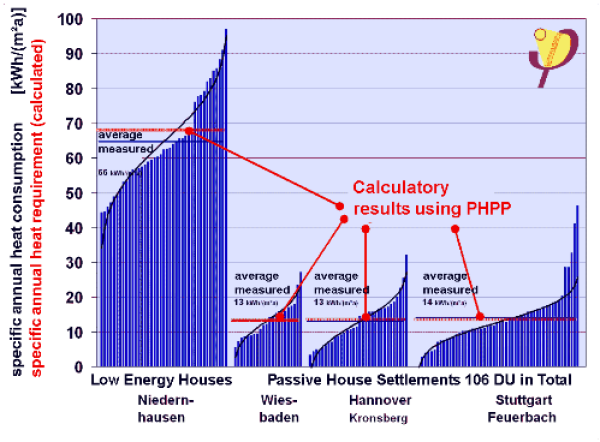

Note: It is only possible to compare average measured results from sufficiently large statistical samples because individual consumption values fluctuate too much on account of the different user behaviours. The average values match the PHPP results almost exactl!
From a scientific point of view it is almost surprising that the results of the average measured values agree so well with the PHPP calculation, as both the accuracy of the measurement and of the calculation have their limitations. Nevertheless, the depicted values are actual measured data, and the calculated results are those which were calculated before the start of construction and already published before completion of the buildings.
A question that often arises is why there is such a significant fluctuation of the energy demand between different users. Noticeably, this is the case for all energy standards and not only for highly energy efficient buildings. Cause for such differences are e.g. different heating temperature setpoints, different internal heat sources (dependening e.g. on how many people live in the space and how often the are home, how much they cook etc.). One important effect to note here is that the absolute fluctuation is much smaller in the Passive House buildings and even the highest consumption is still very low. In other words: Passive House provides robustness and less risk for high energy costs also for occupants that prefer to heat to higher temperatures.
Many more monitoring studies have been carried out since then that confirm similar findings. For example, Mitchell and Natarajan investigated a large sample of built passive houses build in the UK [Mitchell 2020]. They also compared these monitoring results with PHPP calculation, the results corroborate the analysis given here.
See also: Energy efficiency of the Passive House Standard: Expectations confirmed by measurements in practice
PHPP: More accurate than conventional methods
The PHPP was systematically developed by adjusting the utilisation factor of the stationary energy balance approach to match the results of dynamic simulations [AkkP 13]. All simulation models that were used for this purpose had been previously validated in measurements of completed Passive House buildings. The adjustments made were necessary for buildings that require very little energy for heating. To this end, the calculation with the PHPP varies slightly from that of the international ISO 13790 standard (European EN 832). Whilst this difference is not significant for existing/conventional buildings, it strongly affects buildings with very long time constants where ISO 13790 (EN 832) tends to be too positive.
The PHPP uses boundary conditions that are significantly different from other calculation procedures e.g. the German Building Energy Act (Gebäudenergiegesetzt GEG, previously EnEV). There are important reasons for these differences which are discussed in detail in [Feist 2001], include:
- In residential buildings with efficient household appliances, values of about 2.1 W/m² (±0.3) for internal heat sources are realistic during the heating period (rather than 5 W/m², as frequently assumed). The PHPP includes a calculation sheet which allows for more accurate determination of the internal heat sources of a specific building project. Assuming unrealistically high internal heat gains would result in unrealistically low values for heating energy needs, suggesting that very low or even zero-energy houses are possible with moderate building qualities. Practice has shown that this not true.
- Realistic shading factors and dirt which is always present on surfaces should be taken into account for the calculation of solar gains.
- Overall temperature correction factors are often set too low for well-insulated buildings: e.g. for top floor ceilings (realistic values for top floor ceilings are in the range of 1.0 rather than 0.8).
- The airtightness value that is actually achieved, i.e. the measured n50 value must be assumed for the “additional air exchange rate due to leaks and window opening” - as is done in the PHPP and in DIN EN ISO 832.
These and other details lead to differences in calculation results from conventional methods and the PHPP, which are quite significant for energy efficient buildings. Since the algorithms in the PHPP have been developed and validated especially for energy efficient buildings, it provides more accurate results here than conventional calculation methods.
One particular aspect is the accurate calculation of the peak heating load. As the dynamics in a high performance buildings with high thermal intertia are very different to a buildings, conventional methods for heating load calculations based primarily on outside temperatures are too pessmistic and lead to overdimensioned heating systems for Passive House buildings. For this reason the PHPP includes an alternative method for calculating the heating load that was developed and validated specifically for high performance buildings.
Validation Studies of PHPP

ANSI/ASHRAE Standard 140-2017
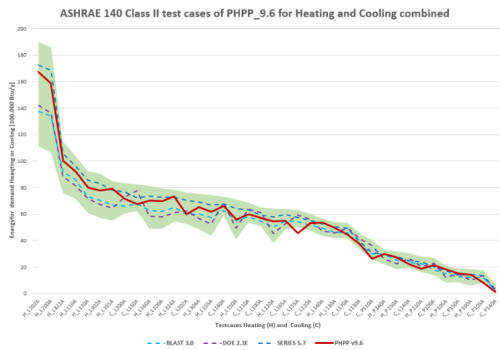
The Passive House Planning Package (PHPP) version 9.6 was evaluated in accordance with ANSI/ASHRAE Standard 140, a comparative testing method for building energy programs. The validation tests consist of a series of carefully described sample case building plans. Results from modelling different test cases with the software being tested are compared to those of reference software results. The class II test cases, geared towards annual building energy use, comprise a total of 38 test cases, 21 for heating and 17 for cooling.
Passive House Canada, Passive House California, New York Passive House and the Passive House Institute contracted Remi Charron Consulting Services, to independently test PHPP version 9.6 using ANSI/ASHRAE Standard 140 in order to offer building officials better insights on the comparability of the results in PHPP with standard test tools and thereby enable the acceptance of PHPP as an energy model for building code energy performance compliance.
The standard emphasizes that deviations from the results of the reference software do not necessarily imply that the program tested is wrong. Accordingly, the procedure does not specify explicit pass or fail criteria. However, informative Annex B22 of the standard provides guidance on developing an acceptance range in which the results of the tested software should fall within.
As can be seen in the diagram, the results of PHPP agrees very well with those of the reference software. For heating, PHPP results fell within the acceptance range in all cases. For sensible cooling, PHPP was within the acceptance range for all but one case, where PHPP predicted a cooling demand that was 9% below the lower limit.
The PHPP has already proven its ability to predict the energy use of buildings in many post-occupancy studies. Good agreement with other building simulation programs was also found earlier. The studies of this report support this general experience following the formal test procedure of ANSI/ASHRAE 140.
Full report:
PHPP V9.6 Validation using ANSI/ASHRAE Standard 140-2017
PHPP for existing buildings
PHPP was originally developed and validated for the design of energy efficient buildings with low energy demand. The question arises whether the same method and tool is also applicable and reliable for less efficient buildings, or even existing buildings with very high energy demand. This question was addressed as part of the EuroPHit project. A comparison of PHPP results with results from dynamic simulations revealed that, although some algorithms were developed with highly efficient, well-insulated buildings in mind, the PHPP can be used also for buildings with high energy demand with sufficient accuracy. The full report “Optimisation of the PHPP for old buildings with high energy consumption” can be downloaded from the EuroPHit website.
Full report:
Optimisation of the PHPP for old buildings with high energy consumption
Active cooling algorithms in PHPP
With the adoption of Passive Houses buildings also in hot and humid climates, algorithms for the claculation of the annual cooling energy and the cooling loads were eventually added to the PHPP. These have also been validated against results of dynamic building simulations and compared with in-use montoring results.
See also: PHPP calculations in hot and humid climates.
PHPP example calculations
Anmerkung INTERN: Dieser Teil kann gerne aktualisiert werden.

 Monthly heating balance for the same example terraced house unit. Source: [AkkP 20]. |  PHPP annual heating energy balance (sum of monthly energy balance) for the same terraced Passive House. Solar gains and internal heat sources make up a larger share of heat gains than the heating energy (column on the right). Source: [AkkP 20]. |
Literature
[AkkP 5]Energiebilanz und Temperaturverhalten; Protokollband Nr. 5 des Arbeitskreises kostengünstige Passivhäuser, 1. Auflage, Passivhaus Institut, Darmstadt 1997
Energy balances and thermal characteristics; Protocol Volume No. 5 of the Research Group for Cost-effective Passive Houses, first edition, Passive House Institute, Darmstadt 1997
(only available in German)
[AkkP 13]Energiebilanzen mit dem Passivhaus Projektierungs Paket; Protokollband Nr. 13 des Arbeitskreises kostengünstige Passivhäuser, 1. Auflage, Passivhaus Institut, Darmstadt 1998
Energy balances with the Passive House Planning Package; Protocol Volume No. 13 of the Research Group for Cost-effective Passive Houses, first edition, Passive House Institute, Darmstadt 1998
(only available in German)
[AkkP 20]Passivhaus-Versorgungstechnik; Protokollband Nr. 20 des Arbeitskreises kostengünstige Passivhäuser, 1. Auflage, Passivhaus Institut, Darmstadt 2000
Passive House building services; Protocol Volume No. 20 of the Research Group for Cost-effective Passive Houses, first edition, Passive House Institute, Darmstadt 2000
(only available in German)
[Feist 1994] Thermische Gebäudesimulation; 1. Auflage, 366 Seiten, 1994 (Link zum Simulationsprogramm DYNBIL: Dynamische Simulation) Thermal building simulation, first edition,1994 (link to the article Dynamic Simulation)
[Feist 2001] Stellungnahme zur Vornorm DIN-V-4108-6:2000 aus Sicht der Passivhausentwicklung, CEPHEUS-Bericht, 1. Auflage, Passivhaus Institut, Darmstadt 2001
Statement regarding the Prestandard DIN-V-4108-6:2000 from the Passive House perspective, CEPHEUS Report, first edition, Passive House Institute, Darmstadt 2001
[Mitchell 2020] Mitchell, Rachel and Natarajan, Sukumar: UK Passivhaus and the energy performance gap; Energy and Buildings, Volume 224, 1 October 2020, 110240
https://www.sciencedirect.com/science/article/abs/pii/S0378778820313918
[PHPP 2007] Feist, W.; Pfluger, R.; Kaufmann, B.; Schnieders, J.; Kah, O.: Passivhaus Projektierungs Paket 2007, Passivhaus Institut Darmstadt, 2007
Passive House Planning Package 2007, Passive House Institute, Darmstadt 2007