
affiliate_literature:passive_house_certification
Table of Contents
Affiliate Literature - Quality Assurance and Building Certification
Building Certification Support
| Publication | Year | Organisation | |
|---|---|---|---|
 | Certifying a Passivhaus: Tips and Costs Certifying a Passivhaus: Tips and Costs is a short, practical guide for clients who want to understand what certification involves, what it offers, and how much it’s likely to cost. Developed by the Passivhaus Trust in collaboration with the UK Certifiers Circle, the guidance explains how Passivhaus certification ensures quality, comfort, and performance — and why it’s a critical safeguard against the risks of underperformance, costly rework, or greenwash. | 2025 | Passivhaus Trust (PHT), UK |
 | Building Certifier Scope of Services - A North American Certifiers Circle Guidance The guide serves as a flexible communication tool for certifying buildings to Passive House Institute standards, accommodating diverse project types. Customization is advised based on specific project requirements, with consultation from Certified Passive House professionals crucial to ensuring tailored certification processes and the effective delivery of successful Passive House projects. | 2024 | Passive House Network (PHN) |
 | Passivhaus Certifier Scope of Services This guidance paper offers an overview of the tasks and responsibilities typically involved in the Passivhaus certification process, and provides a generic scope of services to serve as a starting point for discussions and agreements between project teams and certification bodies regarding roles, responsibilities, and expectations for achieving Passivhaus certification. | 2023 | Passivhaus Trust (PHT), UK |
 | Technical Guidance - Passivhaus Quality Assurance: Large & Complex This publication addresses the growing importance of structured quality assurance systems for Passivhaus Standard buildings in the UK, emphasizing the need for effective tools, methods, and collaboration to ensure successful project outcomes while preventing cost overruns and delays. It highlights practical examples and clarifies Passivhaus Standard requirements for construction teams and site managers. | 2015 | Passivhaus Trust (PHT), UK |
Claiming the Standard
| Publication | Year | Organisation | |
|---|---|---|---|
 | Claiming Passivhaus This guidance briefing sets out exactly what it means to claim Passivhaus, and why it matters. With new consumer protection laws now in force under the Digital Markets, Competition and Consumers Act 2024, misleading environmental claims face tougher scrutiny. This fourth edition of Claiming Passivhaus offers clear guidance to help clients, designers, and developers ensure their claims are accurate, robust, and compliant — and to safeguard the value and credibility of the standard itself. | 2025 | Passivhaus Trust (PHT), UK |
 | Misunderstanding Passivhaus Principles This paper shows how attempting to incorporate some Passivhaus building principles without also following the principles of approach introduces significant risks. Two case studies are presented, where the clients were ambitious in their intention to provide reduced operational carbon emissions and lower energy bills for residents – but an ill-defined brief, absence of energy modelling, and lack of attention to fabric and quality led to poor outcomes and significant costs. | 2025 | Passivhaus Trust (PHT), UK |
 | Claiming the Passivhaus Standard This guidance clarifies that buildings cannot claim to be built to Passivhaus Principles as the term Passivhaus can only be used if the Passivhaus Standard has been met. It includes : 1) A road map connecting project outcomes to project terminology 2) The quality assurance and performance requirements of the Passivhaus Standard 3) Guidance around consumer protection from deceptive and misleading conduct | 2025 | Australian Passivhaus Association (APA) |
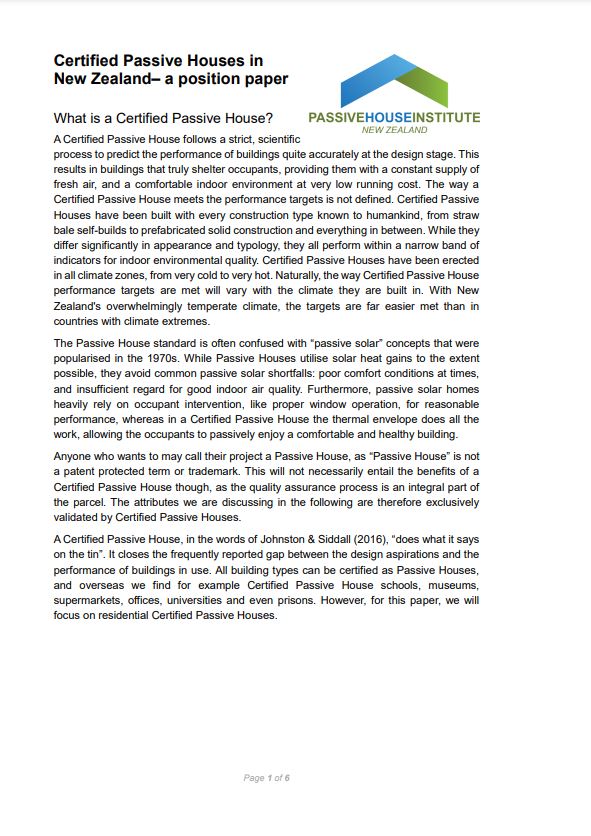 | Certified Passive Houses in New Zealand - a position paper The first Certified Passive House in New Zealand was built in 2012 in Glendowie, Auckland. At the time of writing, there were 19 Certified Passive Houses in New Zealand registered in the international database. The authors know of a similar number of Passive Houses that are in the process of becoming certified. Currently, all Certified Passive House buildings in New Zealand are detached, single family homes, town-houses, apartments and social buildings are however in the pipeline at the time of writing. | 2018 | Passive House Institute New Zealand (PHINZ) |
See also
Click here to read more about Passive House certification
Click here to read more about Affiliate Resources
affiliate_literature/passive_house_certification.txt · Last modified: by yaling.hsiao@passiv.de